MetaTrader API · 8 min read · 2026-06-09
MetaApi WebSocket Alternative: Streaming MT4/MT5 Prices and Account Data
By MetaTrader API Editorial Team
Looking for a MetaApi WebSocket alternative? Learn how to stream live MT4/MT5 prices, account equity, and real-time order updates using a direct protocol-level API.
Looking for a MetaApi WebSocket alternative? Learn how to stream live MT4/MT5 prices, account equity, and real-time order updates using a direct protocol-level API.
When building an algorithmic trading model, a prop firm dashboard, or a copy trading app, REST APIs are not enough. Polling a server every second for price updates will immediately trigger rate limits and introduce unacceptable latency.
You need real-time data streaming.
While the MetaApi WebSocket implementation is widely used, it relies on their proprietary SDKs to manage state synchronization between their cloud-hosted headless terminals and your backend. For developers experiencing latency stacking or looking to reduce dependency bloat, finding a MetaApi websocket alternative is a top priority.
In this technical guide, we break down how to stream live pricing and account data directly using a protocol-level MetaTrader price streaming API like MetaTrader API.
1. Cloud SDK Streaming vs Direct Protocol Streaming
Before diving into the code, it is vital to understand the architectural difference between how traditional cloud wrappers stream data compared to a direct API.
- The Cloud Wrapper Way: The broker sends data to a cloud-hosted headless terminal. The terminal pushes the data to a cloud synchronization server. The server pushes the data to your Node.js or Python app via a heavy SDK listener.
- The Protocol Way: By stripping away the headless terminal, protocol-level APIs connect directly to the broker's data feed. You simply open a standard
wss://connection to the API node, which passes the raw JSON data straight to your backend.
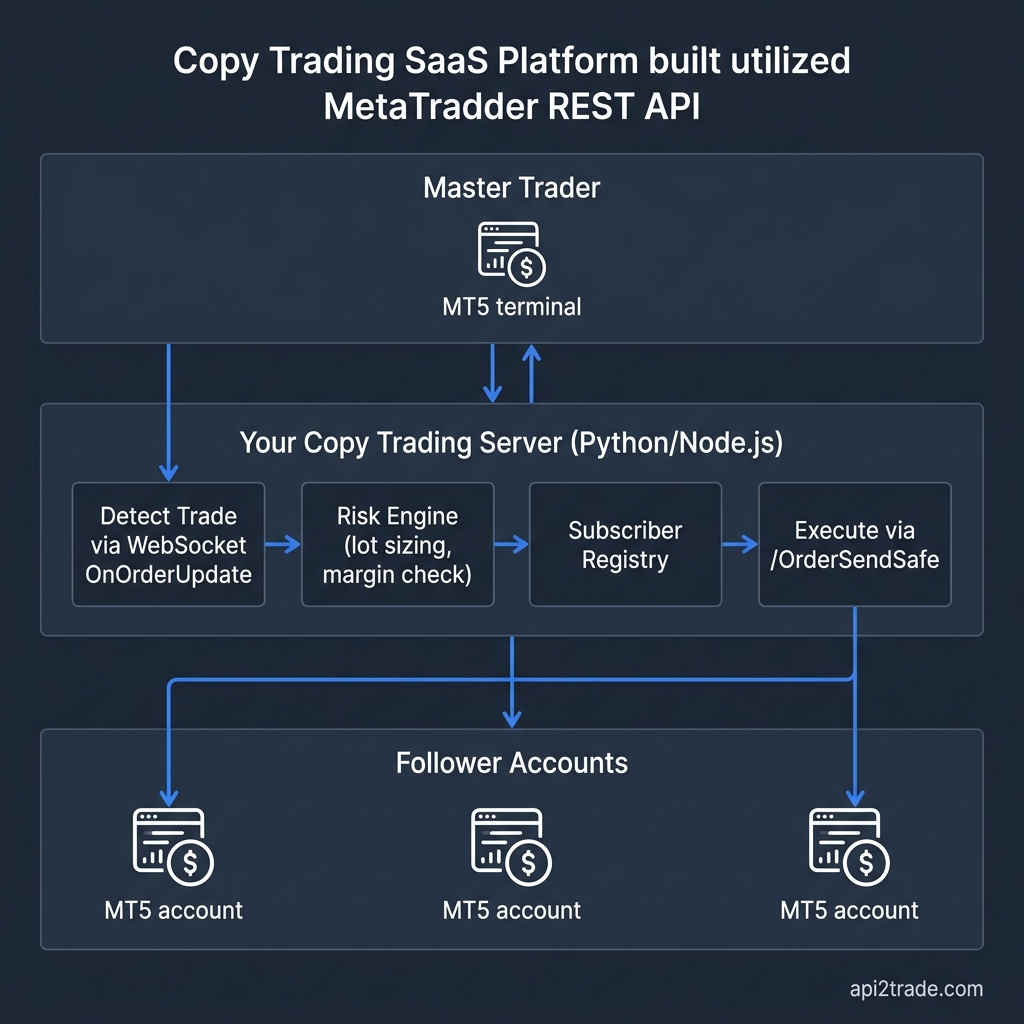 Streaming architecture: WebSockets provide the real-time trigger for rapid REST execution.
2. Streaming Live Prices (Tick Data)
Whether you are building an MT4 WebSocket API integration or an MT5 WebSocket API integration, the MetaTrader API protocol normalizes the data stream.
To stream live prices, you do not need an SDK. Connect the account once in the dashboard, then open one standard WebSocket per account with your API key and account id, and subscribe to the symbols you want.
Endpoint Example (JavaScript / Node.js):
// Node 22 has a global WebSocket; on Node 18-20: npm i ws
const ws = new WebSocket(`wss://hrx.info/v1/stream?apiKey=YOUR_API_KEY&id=YOUR_ACCOUNT_ID`);

ws.onopen = () => {
  console.log('Connected to the price stream');
  ws.send(JSON.stringify({ action: 'subscribe', symbol: 'EURUSD' }));   // quotes need a subscription
};

ws.onmessage = (m) => {
  const frame = JSON.parse(m.data);            // { type: 'QUOTE' | 'POSITIONS' | 'TRADE', data: ... }
  if (frame.type !== 'QUOTE') return;
  const tick = frame.data;
  // Output: EURUSD - Bid: 1.08502 | Ask: 1.08505
  console.log(`${tick.symbol} - Bid: ${tick.bid} | Ask: ${tick.ask}`);
};
Because MetaTrader API enterprise clusters can be deployed directly in major financial hubs (Equinix LD4, NY4, or TY3), the time it takes for a price tick to travel from the broker to your backend is measured in single-digit milliseconds.
3. Streaming Account State and Order Updates
For prop firm dashboards or copy trading platforms, live pricing is only half the battle. You also need to know the exact moment a trade is executed, hits a Stop Loss, or is modified.
Instead of running continuous REST loops against /AccountSummary and /OpenedOrders, listen to the same WebSocket: every executed deal arrives as a TRADE frame (with magic, comment, commission, swap, profit and the position it belongs to), and every change of the open positions as a POSITIONS frame. No subscription needed for these — they are always sent.
Endpoint Example (Python):
import asyncio
import json
import websockets

async def stream_order_updates(api_key, account_id):
    uri = f"wss://hrx.info/v1/stream?apiKey={api_key}&id={account_id}"

    async with websockets.connect(uri) as ws:
        print("Listening for trade events...")

        while True:
            frame = json.loads(await ws.recv())
            if frame["type"] == "TRADE":
                deal = frame["data"]
                # Example logic for a copy trading master account
                print(f"Master executed a deal on {deal['symbol']}. Triggering follower accounts...")
                # Trigger parallel /OrderSend REST requests here
            elif frame["type"] == "POSITIONS":
                print("Open positions changed:", len(frame["data"]))

# asyncio.run(stream_order_updates("YOUR_API_KEY", "YOUR_ACCOUNT_ID"))
This event-driven architecture is the foundation of high-performance fintech apps. By relying entirely on WebSockets to trigger your logic, your backend remains idle (consuming zero CPU) until the exact moment an actionable event occurs.
Conclusion: Upgrade Your Streaming Architecture
If your application requires high-frequency streaming, relying on bloated cloud wrappers and SDK listeners will eventually create a performance bottleneck.
By migrating to a direct, protocol-level MetaTrader price streaming API, you gain access to raw wss:// endpoints. This not only decreases latency but also gives your engineering team complete architectural control over how connections are managed, reconnected, and scaled.
Ready to build a faster streaming layer?
Already using MetaApi and considering a switch?
👉 Request a Demo Today and our engineering team will check your current architecture and show you how seamlessly your WebSocket streams can be migrated to MetaTrader API.
Ready to integrate the MetaTrader API?
Set up in under 30 minutes. No terminal required.
Get Started →