Guide · 9 min read · 2026-10-05
MT5 Manager API Alternative: Trade Accounts at Any Broker
By MetaTrader API Engineering Team
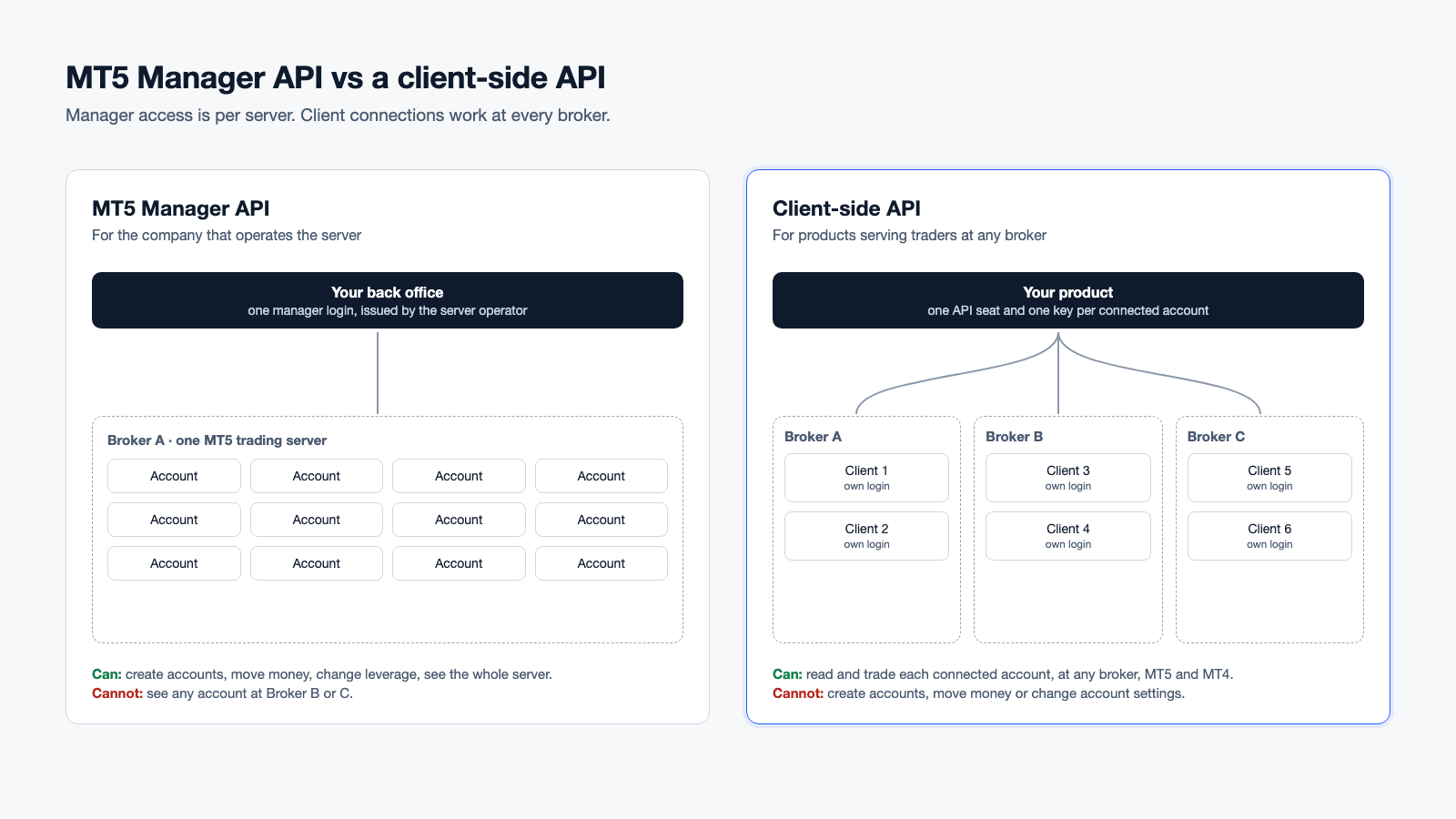
The MT5 Manager API only works on one broker's server. Compare it with a client-side API that reads and trades accounts at any broker, and when each fits.
Short answer: the MT5 Manager API is a broker tool. It works on one MetaTrader 5 trading server, with a manager login that only the company operating that server can issue. If you are not that broker, the practical alternative is a client-side API: each account holder connects their own MT5 account with their own login, and you read and trade those accounts through REST and WebSocket, across any number of brokers. You give up server-wide powers such as creating accounts or moving money. In return you need no Manager API access, no broker relationship, and no single-server limit.
Release note: the
ORDERS(pending orders) andHEARTBEATWebSocket events, and the position and order snapshots sent on connect, go live on 11 October 2026.
This page explains both options, what each one can and cannot do, and how to choose. It is for teams building copy-trading services, prop-firm dashboards, IB and partner tools, trading journals and risk monitors.
What the MT5 Manager API is
MetaTrader 5 is a client-server platform. The broker runs the trading server; traders connect to it with the MT5 app. The Manager API is the programmatic interface for the people who run that server. With a manager account it lets software:
- create, edit and archive trading accounts on that server
- post deposits, withdrawals and credit
- change account groups, leverage and trading permissions
- read positions, orders, deals and balances for every account it is allowed to see
- receive server-wide events as they happen
Two properties follow from that design. First, access comes from the server operator: the broker (or the white-label provider whose server it is) creates the manager login and decides what it may do. Second, the scope is one broker's MT5 platform: a manager login at Broker A sees nothing at Broker B.
If you are the broker, this is the right tool. If you are building a product for traders who hold accounts at many different brokers, it does not fit: a broker will rarely give an outside company manager rights so it can monitor the broker's clients, and even then you would cover only that one broker.
The alternative: connect each account from the client side
A client-side API does what the MT5 app does, for many accounts at once. The account holder gives your product their MT5 login, password and server name. You connect the account once, and from then on you can read everything the account holder could see in their own app, and place the trades they could place:
curl -G "https://hrx.info/ConnectEx" \
  -H "x-api-key: YOUR_TENANT_KEY" \
  --data-urlencode "user=51234567" \
  --data-urlencode "password=CLIENT_PASSWORD" \
  --data-urlencode "server=Exness-MT5Real8"
The response contains the account's id and its own API key. Every connected account runs in its own isolated connection, so one account's load does not queue behind another's.
Because the connection is made with the account holder's own credentials, the broker does not need to cooperate or even know your product exists. The same code works at every broker whose server is reachable. The MetaTrader API server directory currently lists 8,006 MetaTrader server names (4,299 MT5 and 4,207 MT4; some brokers run both), so server=Exness-MT5Real8 or server=ICMarketsSC-MT5-4 is resolved to the right address automatically.
Side by side
| MT5 Manager API | Client-side API (MetaTrader API) | |
|---|---|---|
| Who can use it | The company operating the MT5 server, or a partner it grants a manager login | Anyone the account holder gives their login to |
| Which accounts | Accounts on that one server | Any account at any reachable broker, MT5 and MT4 |
| Credentials | One manager login from the server operator | Each account's own login, password and server |
| Create accounts, deposits, leverage, groups | Yes | No. These stay with the broker |
| Read balance, equity, positions, history | Yes, server-wide | Yes, per connected account |
| Place and manage trades | Yes, as dealer operations on the server | Yes, as the account's own orders: open, close, partial close, modify, pending orders |
| Real-time events | Server-wide event stream | WebSocket per account: trades, positions, pending orders, quotes, heartbeat |
| Integration | MetaQuotes SDKs (C++, .NET, Python) and the MT5 server Web API, all requiring a manager login | REST and WebSocket from any language, with each account's own login |
| Restrict to read-only | Through manager permissions | Read-only API keys: every trading endpoint answers HTTP 403 |
| Cost | Part of running an MT5 server; set by the server operator | One API seat per connected account: $12 to $14 per 28 days |
What you can build without the Manager API
These are the products we see teams build most often, and the parts of the API each one relies on.
Copy trading and signal services
One market-data account feeds your signal logic. Each follower account is connected with its own key, and every signal goes out to all followers at once through OrderSend, sized per account by contract size and lot step. A clientOrderId on each order makes retries after network errors safe, and a magic number ties every position back to the signal that opened it. The full design, with tested code, is in Execute one trading signal on hundreds of MT5 accounts.
Prop-firm evaluation on traders' own accounts
Instead of opening evaluation accounts on a server you operate, traders connect accounts they already hold. Your backend reads AccountSummary for balance and equity, EquityHistory and BalanceHistory for drawdown curves, OrderHistory for closed trades and TradeStats for performance figures. Use read-only API keys so the evaluation system can never place a trade, even by mistake. Rule enforcement (daily loss, maximum drawdown, minimum trading days) runs in your code against that data; see building prop-firm rule enforcement on MetaTrader accounts.
IB and partner dashboards
An introducing broker or affiliate wants to see how referred clients trade: volume, activity, open risk. With client consent, each account is connected read-only, and your dashboard aggregates across brokers, which a Manager API login at one broker could never do.
Trading journals and analytics
A journal needs complete history and live state: OrderHistory with commission, swap and magic number per deal, OpenedOrders for what is open now, and the WebSocket TRADE event for every new execution. Traders connect once and the journal stays current without polling.
Risk monitors
A risk monitor watches equity and exposure across many accounts and reacts. Positions arrive as full snapshots on every change through the WebSocket POSITIONS event, and a single /OnConnectState socket reports every account that connects, disconnects or has its credentials rejected.
What a client-side API cannot do
The limits:
- No account creation. Accounts are opened at the broker. Your onboarding flow sends the trader there and collects the login afterwards.
- No money movement. Deposits, withdrawals and credit are broker functions. The API reads them (
BalanceHistorylists every non-trade balance operation) but cannot create them. - No account settings. Leverage, account type and trading permissions are set by the broker.
- One seat per connected account. Reading 10,000 accounts means 10,000 connected accounts. There is no single login that sees a whole server.
- The account holder must consent. You need their credentials. When they change their password, the connection reports a credentials error and you ask them for the new one.
If you need any of the first three, you need the broker, and the Manager API is the right tool. If you need data and execution across accounts at many brokers, the client-side API is.
How the two can work together
Some brokers use both. The Manager API runs back-office operations on their own server, and a client-side API powers a product that must also include accounts their clients hold elsewhere, for example a copy-trading service where signal providers trade at other brokers. Nothing about one prevents the other.
Security of client credentials
When your product holds other people's MT5 passwords, ask any provider how they are stored. On MetaTrader API:
- passwords are encrypted with AES-256-GCM, with a random IV and an authentication tag per password; the key is held separately from the database
- they are never returned by the API, never shown in any dashboard and never written to logs
- they are decrypted only to establish the broker connection
- when an account is removed, its stored password is deleted permanently after a 7-day restore window
Your own backend should apply the same rule: store the account id and its API key, and never keep the trader's MT5 password longer than the single ConnectEx call.
Choosing: a short checklist
Choose the Manager API if all of these are true:
- You operate the MT5 server, or a broker has given you a manager login.
- All the accounts you care about are on that server.
- You need to create accounts, move money or change account settings.
Choose a client-side API if any of these is true:
- The accounts are at several brokers, or at brokers you have no agreement with.
- You only need to read accounts and place the account holders' own trades.
- You want to start without a broker partnership or Manager API access.
Frequently asked questions
Can I get MT5 Manager API access without being a broker? Only if a broker or white-label operator gives you a manager login on its server, and then only for that server. MetaQuotes licenses its server platform to brokers; it does not offer cross-broker manager access to third parties.
Is a client-side API allowed by brokers? The account holder logs in with their own credentials, exactly as the MT5 app does. Whether a particular use is allowed (for example copy trading or third-party account management) is governed by the broker's client agreement and your local regulation, not by the technology. Check both for your product.
How many accounts can one integration handle? Each account is one API seat. A new tenant starts with a seat limit that is raised on request; for deployments in the hundreds or thousands, capacity is reserved before onboarding and accounts are connected in batches.
Do I need the account's master password? To trade, yes. For read-only use, combine the connection with read-only API keys, so your systems cannot place orders whatever password was used.
Does it work with MT4 too? Yes. MT4 accounts connect through the same API and keys, with the same endpoint set plus MT4-style aliases.
What does it cost? One connected account uses one API seat, billed per 28-day period on a graduated scale: $14 for seats 1 to 4, $13 for seats 5 to 19 and $12 from seat 20. There are no licence fees and no charges for API traffic.
Related guides
- Execute one trading signal on hundreds of MT5 accounts without duplicate orders
- How brokers automate account management with a MetaTrader API
- MT5 API for prop trading firms
Create an account and connect one account to see the full API, including WebSocket events, in a few minutes.
Ready to integrate the MetaTrader API?
Set up in under 30 minutes. No terminal required.
Get Started →