Comparisons · 14 min read · 2026-06-09
MetaApi vs MetaTrader API (2026): Pricing, Features & Migration
By MetaTrader API Editorial Team

MetaApi vs MetaTrader API on verified 2026 prices ($30/month plus usage vs $14 per account), architecture, SDKs and migration, and when each one wins.
You have decided to build something on MetaTrader. A copy trading platform, a prop firm dashboard, an AI trading bot, or a multi-account monitoring tool. Now you are evaluating which MetaTrader REST API service to build on — and the two names that keep coming up are MetaTrader API and MetaApi.
This article is a thorough, factual comparison of both services. Every claim is based on publicly available information from each company's own website and documentation. No guesswork, no vague claims.
Bottom line up front: Both are legitimate, professional services. The right choice depends entirely on your use case, your technical preferences, and how you intend to scale.
The short answer (prices checked on both websites on 24 October 2026):
- MetaApi is an SDK-first cloud platform. The Regular subscription is $30 per month (7-day trial, activated once; one MetaTrader account included), and API access is billed pay-as-you-go on top. Extended is $100 per month; the MetaTrader Manager API add-on is $125 per MT server per month.
- MetaTrader API is plain REST, WebSocket and gRPC that any language can call. It costs $14 per connected account per month ($13 from the 5th, $12 from the 20th), with no usage fees and no trial.
- Choose MetaApi if you want its ready-made products (CopyFactory, MetaStats). Choose MetaTrader API for a known price per account, no SDK lock-in, and MT4 and MT5 behind the same endpoints (MT5 API, MT4 API, Python).
What Each Service Is
MetaTrader API
MetaTrader API (metatraderapi.net) is a pure REST and WebSocket bridge for MetaTrader 4 and MetaTrader 5. Any programming language that can make HTTP requests — Python, JavaScript, Go, C#, Java, PHP, Ruby, anything — can talk to it directly. There are no proprietary SDKs you must install. You call the endpoints, pass your credentials, and get JSON back.
The pricing model is per seat: each connected MT4 or MT5 account is one seat at $14 per month, dropping to $13 from the 5th seat and $12 from the 20th. Every seat includes REST, WebSocket streaming, MT4 and MT5, with no per-request charges (the rate limit is 20 requests/second per API key). MetaTrader API stores customer data in the EU (Finland and Germany) and publishes its measured uptime on a live status page. The company is registered in the United States (Sheridan, WY); security and data-handling details are in the Trust Center.
MetaApi
MetaApi (metaapi.cloud) is a cloud platform built around proprietary SDKs for JavaScript/TypeScript, Python, Java, and C#. Rather than a single API product, it is a suite of separate APIs:
- MetaApi — core trading API (account data, order execution, market data)
- CopyFactory — dedicated copy trading API
- MetaStats — trading statistics and analytics API
- Provisioning API — MT account management and server provisioning
- Risk Management API — risk rules and monitoring
- MetaTrader Manager API — broker-level manager access
Each of these is a distinct product with its own documentation, pricing tier, and integration path. MetaApi's subscriptions start at $30 per month, with API usage billed pay-as-you-go on top.
Architecture and Integration Style
This is the most important technical difference.
MetaTrader API is a language-agnostic REST API. You authenticate with an API key in the x-api-key header, pass the account UUID as id, make GET requests, receive JSON. Every endpoint is documented with exact parameter names and response fields. If you can run curl, you can test any endpoint with one command. Your code does not depend on any third-party library that MetaApi controls, updates, or breaks.
# MetaTrader API: any HTTP client works — here in curl
curl "https://api.metatraderapi.net/AccountSummary?id=ACCOUNT_UUID" \
  -H "x-api-key: YOUR_API_KEY"
MetaApi is SDK-first. The primary integration path is through their Node.js or Python SDK:
# MetaApi: requires their proprietary SDK (pip install metaapi-cloud-sdk)
import asyncio

async def main():
    from metaapi_cloud_sdk import MetaApi
    api = MetaApi(token='YOUR_TOKEN')
    account = await api.metatrader_account_api.get_account('account_id')
    connection = account.get_rpc_connection()
    await connection.connect()
    info = await connection.get_account_information()

# asyncio.run(main())  # run it once the SDK is installed
Neither approach is wrong. The question is which fits your situation:
- If you want zero SDK dependency and the ability to call the API from any language, script, or tool (even a spreadsheet macro) → MetaTrader API
- If you prefer a higher-level abstraction and are comfortable committing to Node.js or Python with their SDK → MetaApi
Pricing — The Most Critical Decision Factor at Scale
Pricing is where these two services diverge most dramatically for SaaS builders.
MetaTrader API Pricing (verified from metatraderapi.net, October 2026)
There is one plan, billed per seat. A seat is one connected MT4 or MT5 account, charged upfront for a full billing month. The price is graduated — each price applies to the seats in its range:
| Seats | Price per seat (per month) | Accounts | Platforms |
|---|---|---|---|
| Seats 1–4 | $14 | 1 account per seat | MT4 or MT5, mixable |
| Seats 5–19 | $13 | 1 account per seat | MT4 or MT5, mixable |
| Seat 20 onward | $12 | 1 account per seat | MT4 or MT5, mixable |
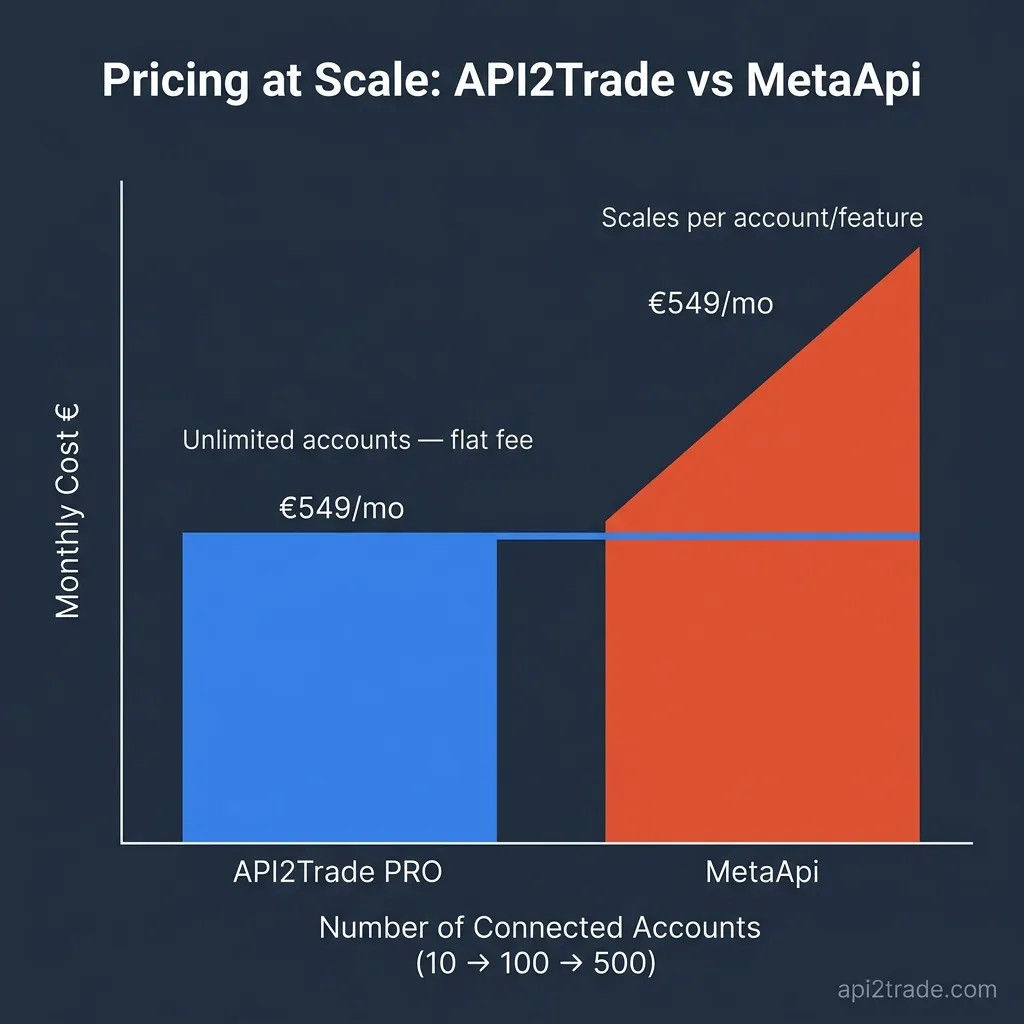
The critical word is predictable. Your cost is a known number per connected account — 10 seats cost $134 and 50 seats $623 per month (more than 50 seats by arrangement; at the same graduated rates 100 seats would be $1,223 per month) — and the price per seat falls as you grow. There are no per-request fees and no extra products to switch on: REST, WebSocket streaming, MT4 and MT5 are in every seat. When an account drops off, disconnecting it frees its seat for another account within the paid billing month at no charge. For a SaaS business with dozens of follower accounts, the API bill becomes a simple line item you can price into your own subscription.
MetaApi Pricing
As published on metaapi.cloud/#pricing on 24 October 2026 (excluding VAT/GST):
| Plan | Price | What the page says it includes |
|---|---|---|
| Regular subscription | $30 per month | 7-day trial (activated once), one free MT account, shared API servers; API access billed pay-as-you-go on top |
| Extended subscription | $100 per month | the same trial and free account, priority support, option to add backlog tasks; API access billed pay-as-you-go on top |
| MetaTrader Manager API add-on | $125 per MT server per month | for brokers or broker partners with MT manager access |
The per-account and per-request API prices themselves were not shown on that date: the page said "API access pricing is temporarily unavailable". Check the page before you decide, because these prices change.
The pattern that follows: with MetaApi you pay a subscription plus usage, so the bill depends on how many accounts you run and how much you call the API. With MetaTrader API the bill is seats × price: 1 account costs $14 per month, 10 accounts $134 and 50 accounts $623, whatever the request volume (within 20 requests per second per key).
Feature-by-Feature Comparison
| Feature | MetaTrader API | MetaApi |
|---|---|---|
| MT4 support | ✅ Yes | ✅ Yes |
| MT5 support | ✅ Yes | ✅ Yes |
| Integration style | Pure REST + WebSocket | SDK-first (JS/Python/Java/C#) |
| Language requirement | Any HTTP-capable language | Node.js / Python / Java / C# SDK |
| Expert Advisor (EA) to run yourself | ❌ None | ❌ None |
| Pricing model | Per seat, graduated ($14 → $13 → $12), everything included | Subscription ($30 or $100 per month) + pay-as-you-go API usage |
| Entry price | $14 per month (1 seat) | $30 per month + API usage (one MT account included) |
| Cost at scale | $623 per month for 50 seats (more by arrangement) | Scales with usage |
| Real-time WebSocket | ✅ Native — one /v1/stream socket per account: QUOTE, CANDLE, POSITIONS, ORDERS, TRADE frames |
✅ Via SDK streaming |
| Trade execution | ✅ /OrderSend (MT4 and MT5, retry-safe with clientOrderId) |
✅ Via trading API |
| Copy trading | ✅ Build your own with REST+WebSocket | ✅ CopyFactory SDK (pre-built) |
| Analytics / stats | ✅ /TradeStats, /EquityHistory, /TradeUnrealizedPL |
✅ MetaStats API (separate product) |
| Risk management | ✅ Build custom logic with /AccountSummary |
✅ Risk Management API (separate product) |
| Customer data | Stored in the EU (Finland & Germany), see the Trust Center | Cloud-based, multiple regions |
| Uptime | Measured and published on the status page | Published in their SLA docs |
| Compliance | Privacy policy + DPA · Trust Center | Published in their compliance docs |
| Trial | ❌ No trial; test on a broker demo account (paid seat) | ✅ 7-day trial, activated once |
| Support | ✅ Human support 7 days a week (chat, email, Telegram) | ✅ Varies by plan |
Developer Experience: Where Each Wins
MetaTrader API Developer Experience
The endpoint structure is predictable and consistent. Every endpoint follows the same pattern: GET /<Endpoint>?id=ACCOUNT_UUID¶m=value (for example GET /GetQuote?id=ACCOUNT_UUID&symbol=EURUSD) with your key in the x-api-key header. You can test every single endpoint with one curl command. The documentation at app.metatraderapi.net/docs is a standard REST reference — no special tooling required.
The WebSocket, wss://api.metatraderapi.net/v1/stream?id=ACCOUNT_UUID, is a standard WebSocket upgrade connection, authenticated with the same x-api-key header. You send {"action":"subscribe","symbol":"EURUSD"} for quotes and candles; positions, pending orders and trades arrive without a subscription. Any WebSocket library in any language connects to it.
Best for: Developers who value simplicity, predictability, and language freedom. Teams that already have HTTP infrastructure and don't want to add SDK dependencies.
MetaApi Developer Experience
MetaApi's SDKs abstract a lot of complexity — session management, reconnection logic, state synchronization. For JavaScript or Python developers who want to write less boilerplate, the SDK can accelerate initial development.
The trade-off is SDK coupling. Your codebase depends on their library version, and updates to the SDK may require code changes. The multi-product architecture also means you are learning and integrating several different APIs (MetaApi + CopyFactory + MetaStats) rather than a single unified interface.
Best for: Developers committed to JavaScript or Python who want higher-level abstractions and are comfortable with SDK dependency. Teams that want a pre-built copy trading layer (CopyFactory) without writing replication logic from scratch.
5 Scenarios: Which to Choose
Scenario 1 — Solo Developer, Single Account Bot
Your situation: You want to connect one personal MT5 account and run an automated strategy.
Recommendation: Either works. MetaApi's 7-day trial lets you try it; after that the Regular subscription is $30 per month plus API usage. A single MetaTrader API seat is $14 per month, all included. Choose based on your preferred language and how much control you want over the integration.
Scenario 2 — Building a Copy Trading SaaS (Dozens of Follower Accounts)
Your situation: Master account + multiple follower accounts, your own subscriber management, custom risk rules.
Recommendation: MetaTrader API per-seat. A master and 49 follower accounts (50 seats) cost $623 per month, and every seat from the 20th onward is billed at $12. The REST + WebSocket architecture gives you complete control over your copy logic — lot sizing, symbol mapping, risk gates, partial closes — on the same seats, with no separate copy-trading product to buy. With MetaApi, each additional account and each additional product (CopyFactory) increases your monthly cost.
See: How to Build a Copy Trading Platform with MT5 REST API →
Scenario 3 — Prop Firm Challenge Platform (Many Client Accounts)
Your situation: Onboard challenge traders, monitor their drawdown rules, auto-liquidate on violation, generate performance reports.
Recommendation: MetaTrader API per-seat. One seat per challenge account + REST endpoints for account summary, equity history, and order monitoring make this architecture straightforward. Your infrastructure cost per account is known in advance — 50 accounts cost $623 per month, and more than 50 seats are available by arrangement — and when a challenge ends, you disconnect the account and reuse the seat for the next trader within the paid billing month at no charge.
See: MT5 API for Prop Trading Firms: Challenge Automation →
See: Build Prop Firm Rule Enforcement on MetaTrader Accounts →
Scenario 4 — Forex Broker CRM Integration
Your situation: Sync live account data (balance, equity, open positions) into a CRM system for your clients.
Recommendation: MetaTrader API. Standard REST calls integrate with any CRM platform — Salesforce, HubSpot, custom — via simple HTTP requests or Zapier webhooks. No SDK installation required on the CRM side.
See: MetaTrader API & CRM Integration: Salesforce Workflow Guide →
Scenario 5 — AI Trading Bot with OpenAI Integration
Your situation: Pass live market data and account state to an LLM, execute trades based on AI signals.
Recommendation: MetaTrader API. The pure REST architecture means you can pass any API response payload directly into your Python AI pipeline without SDK compatibility concerns. WebSocket quote streams feed into your model in real time.
See: How to Build an AI Forex Trading Bot →
Honest Assessment: Where MetaApi Has an Advantage
A fair comparison means acknowledging where the competitor genuinely wins:
- A trial. MetaApi offers a 7-day trial (once per customer). MetaTrader API has no trial; the entry point is one seat at $14 per month, tested with a broker demo account.
- Pre-built copy trading SDK. MetaApi's CopyFactory is a ready-made copy trading layer. If you want to deploy copy trading without writing your own replication engine, CopyFactory gets you there faster than building from scratch on any REST API.
- Higher-level abstractions. MetaApi's SDK handles reconnection, state management, and event queuing automatically. This reduces boilerplate for SDK-supported languages.
- Established GitHub presence. MetaApi has a visible open-source GitHub with multiple SDK repositories. This appeals to developers who want to inspect library internals.
Honest Assessment: Where MetaTrader API Has an Advantage
- Predictable cost at scale. A known price per connected account that drops to $12 from the 20th seat, with no per-request fees and seats you can reuse when accounts churn, is a structural advantage for any SaaS business with a growing user base.
- Language freedom. Any language. Any framework. Any tool. No SDK installation, no SDK version conflicts, no migration cost when the SDK updates.
- Transparency. Customer data stored in the EU (Finland and Germany) and a public status page with measured uptime history — you can check the record yourself.
- Single product, single pricing. One seat price covers REST, WebSocket, MT4 and MT5. You are not assembling a stack of separate products (MetaApi + CopyFactory + MetaStats + Risk API) each with its own pricing tier.
- Developer-first REST design. Every endpoint is testable with one curl command, and the first call takes about ten minutes.
Quick Decision Table
| You are... | Choose |
|---|---|
| Building a SaaS with many MT5 accounts | MetaTrader API per-seat |
| Running a prop firm challenge platform | MetaTrader API per-seat |
| Testing a personal bot — 1 account | Either (MetaTrader API $14 per month; MetaApi 7-day trial, then $30 per month + usage) |
| Building in Go, PHP, Ruby, or C++ | MetaTrader API (no SDK needed) |
| Building in JavaScript and want CopyFactory ready-made | MetaApi |
| Integrating with a CRM or webhook system | MetaTrader API |
| Building a broker-level dashboard | MetaTrader API per-seat (MT4 and MT5 mixable) |
| Want a known price per account that gets cheaper with volume | MetaTrader API |
Frequently Asked Questions
What is the main difference between MetaTrader API and MetaApi?
MetaTrader API is a pure REST + WebSocket API — any language, any tool, one per-seat price with everything included. MetaApi is an SDK-first platform with multiple separate products (MetaApi, CopyFactory, MetaStats, Risk Management API) integrated via proprietary SDKs.
Is MetaTrader API cheaper than MetaApi?
For SaaS builders connecting many accounts, MetaTrader API's per-seat pricing is significantly more cost-predictable: $14 per seat per month for seats 1–4, $13 for seats 5–19 and $12 from the 20th seat, with REST, WebSocket, MT4 and MT5 in every seat (50 seats cost $623 per month; more than 50 by arrangement). MetaApi's Regular subscription is $30 per month with API usage billed pay-as-you-go on top (as listed on 24 October 2026), so a single account already costs more than one MetaTrader API seat before any usage fees.
Which MetaTrader API supports both MT4 and MT5?
Both do. Every MetaTrader API seat includes MT4 and MT5 — each seat connects one MT4 or one MT5 account, and you can mix both on the same subscription. MetaApi supports both through their core trading and provisioning APIs.
Do I need to install an EA to use either API?
No. With either service there is nothing for you to install in MetaTrader and no EA for you to run.
Which API is better for building a copy trading platform?
MetaTrader API is better for developers who want full control over copy logic using standard REST + WebSocket. MetaApi's CopyFactory SDK provides a higher-level abstraction with less custom code if you are working in JavaScript or Python.
Related Reading
- MT5 API: REST & WebSocket API for MetaTrader 5 — Endpoints, limits and pricing on one page
- MT4 API for MetaTrader 4 — The same endpoints for MT4 accounts
- MetaTrader Python API — MT4 and MT5 from Python on any OS
- How to Build a Copy Trading Platform with MT5 REST API — Full implementation guide
- How to Become a Forex Signal Provider Without MQL5 — Signal provider architecture
- MT5 API for Prop Trading Firms: Challenge Automation — Prop firm use cases
- How to Build an AI Forex Trading Bot — AI integration guide
- How Brokers Automate Account Management with MetaTrader API — Broker automation
- Build Prop Firm Rule Enforcement on MetaTrader Accounts — Risk enforcement
- MetaTrader API & CRM Integration: Salesforce Workflow Guide — CRM integration
- Forex Broker API Integration: A Complete Developer Guide — Full broker guide
- Low-Latency MetaTrader Infrastructure for Brokers — Infrastructure deep dive
- Build a Reliable Forex & CFD Scalping Bot with MetaTrader API — Scalping bot guide
External references:
- MetaApi official website — For independent verification of MetaApi features
- MetaApi GitHub — Open-source SDK repositories
- MetaTrader API Documentation — Full API reference

Make Your Decision
If you have read this far, you are evaluating these services seriously. Here is the practical recommendation:
Get started with MetaTrader API. Connect a demo MT5 account, run the first API call in your language of choice, and see how the endpoints behave. The first call takes about ten minutes, and there is no SDK to install. A seat is $14 per month; there is no free trial.
→ Create account at app.metatraderapi.net
→ Read the full API documentation
→ Browse all developer guides
Disclosure: This article is written and published by MetaTrader API. All information about MetaApi is sourced from metaapi.cloud and their public documentation as of October 2026. Pricing and features may change — always verify directly with each provider before making a purchasing decision.
MetaTrader®, MT4® and MT5® are registered trademarks of MetaQuotes Ltd. MetaTrader API is an independent service and is not affiliated with, authorized by, or endorsed by MetaQuotes.
Ready to integrate the MetaTrader API?
REST, WebSocket and gRPC for MT4 and MT5. Pay per connected account.
Create account